Thứ Ba, 27 tháng 11, 2018

The Indian temple of more than 100 years old in the heart of Saigon

The Indian temple of more than 100 years old in the heart of Saigon


Built from the end of the 19th century, the Mariamman Temple is open every day to welcome Indians and visitors to worship.


Mariamman Temple, also known as the Independence Pagoda, is located in front of Truong Dinh Street, just a few minutes walk from Ben Thanh Market. The temple was built in 1885, when many Indians began to choose Saigon as their second home.


According to the remaining records, the temple was originally a small hut built by the Indians for worship. It was not until the late nineteenth century that successful Indians began to raise money for the temple. The statue of Mariamman was erected in front of the temple.


Standing from Truong Dinh Street, the main gate of the temple is a multi-storey tower with many gods carrying a face full of authority.


The main hall of the temple is a place of worship and worship. It is also home to the statue of Mariamman. Hinduism in southern India, Mariamman is the goddess of disease and rain, dominating the rural Tamil state.


Mari is considered the goddess of the village associated with the fertile and prosperous rain.


Please click here for more tours in Saigon!


The symbol of the god is a beautiful young woman with red face in red costume, with many hands representing more strength but sometimes only two or four hands.


Every day 30 minutes at 10am and 19h, fire sacrifice ceremony to worship Mariamman and other gods are done. The sacrifice is said to be the rain for good weather, good luck, attendees will be blessed.


Statues of Brahman and Ganesha are placed behind the main hall. These are two famous gods in Indian mythology.


The mysterious temples, temples are not as busy as other Buddhist temples in Saigon but every day there are visitors to worship and pray for the good. The vow is often pressed against the wall where gods are used to read prayers.


Temples open every day. Morning from 7h30 to 12h. Afternoon from 13h30 to 20h. On Friday, the first day of the lunar calendar and the 15th lunar month, the temple is open all day.


Visitors to the temple can only light an incense stick at the main hall. Items such as fruits, items brought, after the offerings will be part of the staff of the temple to bring blessings. The temple only has motorbikes, no car parks.

The oldest water tower in Saigon


The oldest water tower in Saigon


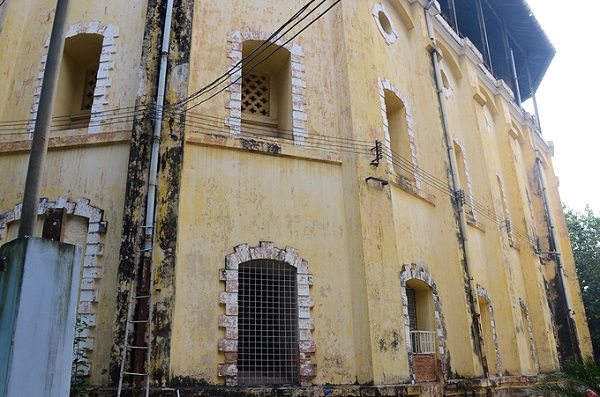
The oldest water tower which was built in the late 19th century at International Square by French Government, District 3, has 132 years of existence.


Located in the premises of Saigon - Sawaco Water Supply Corporation (District 3, Ho Chi Minh City), built by the French in 1886 and never repaired, it is one of the two oldest monuments of Saigon and Indochina. At present, Saigon has nearly 10 hydro towers for over 45 years. The first ship was built at the site of the Turtle Lake in the period 1878 - 1880 but was scrapped in 1921.


This work is designed in oval shape, about 25m high, above are two round stainless steel tanks with a capacity of 1,000 - 1,500 m3. The wall around the water tower is 1.6 - 2 meters thick with the task force.


Like the French architecture in Saigon, the focal point of the water is a series of doors, windows, vent holes designed design.


The whole wall of the water tower is painted yellow.


Water tower has about 20 ventilation holes. There are five holes in the fan assembly, mainly in the back of the building with small design. The entire ground floor and first floor are empty, there is a time Sawaco used this place to work and store records. Exterior lighting is located at the main door, still in operation.


When the mast works, in the rainy season, the water from the wells will flow to the central well, in the dry season, the pump must be used. From the central well, the water is treated and then pumped into the reservoir creating pressure to push water back to the households. After the first dam was damaged, the station stopped operating around 1930 - 1940, then used as a backup water supply in the case of Saigon water shortage. After a period of "mission", the water station ceased operation from 1965 to present.


Many of the walls of the masonry were peeled off, exposed to bricks and no longer as original.


This tower is recognized as a city-level architectural monument in 2016. The manhole management unit had the idea of ​​preserving the tower into a "museum" and a tourist spot. Previously, this 130-year-old architecture was put on the dismantling list but was fortunately kept at the last minute. Currently, to ensure safety, this place is not for visitors to visit because there are works being constructed adjacent to.

The picturesque pagoda on the outskirts of Saigon


The picturesque pagoda on the outskirts of Saigon


Built in Indian architecture with golden towers, Buu Long is one of the most beautiful Southern temples in the South.


Buu Long pagoda was built in 1942. The land was built by a layperson, then the later generations were left to meditate and meditate. The pagoda is located on an area of ​​over 8 hectares. It is located on the western hill of Dong Nai River, in the National Cultural History Park, Long Binh Ward, District 9, Ho Chi Minh City.


Over many years, Buu Long pagoda has more and more works. Since 1982, Vien Minh Vien has been appointed to succeed Buu Long monastery. During this time, he continued to renovate the pagoda to a pagoda that represents the original Buddhist culture in Vietnam.


In 2007, the Great Observatory of Gotama Cetiya, where the relics of the Buddha and the great saint were built, was built on 2,000 square meters, about 70 meters above sea level. The tower is built according to the culture of Funan. By 2010, it will be completed. This works also resonates after the inauguration.


In the Theravada Buddhism, Buu Long is now the most modern and beautiful construction site in the South. The main hall of Buu Long Pagoda is also renovated many times.


As a member of the National Cultural History Park, the pagoda is not only religious, but also a pagoda art to people to visit and visit.


The 5-storey tower is open for two days. From 8 am to 10 pm, from 14h to 16h at the address of 81/1 Nguyen Xien pagoda, guests only need to look far to see the tower.


In the tower is the relics are worshiped under the dome decorated as a forest of meditation.


On the floor, visitors and Buddhists can see the scenery of Saigon and other neighboring provinces.


Indian architecture is bold in the way of carving the windows of the tower.


The location of the famous bodhi tree of the temple is where the Buddhists often come to enjoy.


The large area allows the corridors to be ventilated next to the trees.


Publication of Buddhist publications.


The picturesque pagoda in the outskirts of Saigon According to the primitive Buddhist system of Namthong, in the temple, it is easy to see only the Buddha statue, the pagoda is not suspicious smoke as the North.


The top of the tower is of gold and the structure of the tower resembles some of the temples in Thailand, so many people are used to calling Buu Long Pagoda, a Thai temple, without knowing the temple is Vietnamese. Not only the Buddhists are old, the beauty of the temple also attracts young people to visit.


Southerners usually eat porridge, lunch at lunch (main meal of the day). The Buddhist tradition is not strictly vegetarian as in the Theravada Buddhism, which is allowed to use salty, but must be timely, not seen, not suspected and not heard (seen) creatures killed for themselves.


The same name Buu Long Pagoda district 9 or mistaken for a resort named Buu Long in Bien Hoa, which also has a temple called Buu Duc. Buu Long Pagoda is about 23 km from Ho Chi Minh City. From Thu Thiem tunnel, go straight to Mai Chi Tho street, turn right on Nguyen Thi Dinh street, go down Giong Ong To bridge, turn right at Nguyen Duy Trinh street, continue Nguyen Duy Trinh street to Nguyen Xien street, At the end of Nguyen Xien street, turn left and continue for about 4 km.


Visitors heading Nha Be, District 7, the western provinces should go to Nguyen Van Linh, Phu My Bridge, turn Nguyen Duy Trinh crossroads, turn right, a few kilometers Nguyen Duy Trinh street to Nguyen. At the end of the turn, you have to run 4 km. People in the Eastern provinces, Thu Duc, Hoc Mon, Cu Chi, should find ways to Nguyen Van Viet, running all the way to District 9, turn right to Nguyen Van Tang, run about 1 km, Nguyen Van Increase Nguyen Xien and go 4 km further. Note to go to the temple to see more beautiful.

Beautiful Saigon through the lens of photographers

Beautiful Saigon through the lens of photographers


Peaceful and animated are the opposite beauty coexisting in Saigon and are appeared by photographers in the frame.


Located in the transition area between the South East and the South West, Ho Chi Minh City consists of 19 districts and 5 districts. It is not only a big city, a key economic center but also a destination for many domestic and foreign tourists. Picture: Thai Ton Hao.


Recently, the Saigon Photo Contest organized by Ho Chi Minh City Photography Association has received more than 3,000 pictures of more than 200 authors. The competition revolves around themes of human values ​​in life in Saigon. Picture: Nguyen Xuan Trang.


Traffic is one of the most impressive things for tourists, especially for foreigners. Traffic jams are still happening at the center lines during peak hours, and many visitors consider this to be the "madness" of the city. Picture: Nguyen Thi Ngoc Thao.


Besides the bustling and crowded, many photographers choose to show Saigon peacefully through images such as barbers, railroads, alleys, villages ... Photo: Phan Tuan Long.


The moment of dance of the elderly in the pedestrian Nguyen Hue. Photo: Doan Doan.


The culture of the city has also been chosen for such as the boat racing festival taking place at the Thi Nghe Canal on the occasion of the year, the temple or the wedding day, trading in the markets ... Photo: Kieu Anh Dung.


Cai Luong performance at a stage in Saigon. Photo by Huynh My Thuan.


The photo captures the moment of thousands of phones glowing at the countdown festival in Nguyen Hue pedestrian street that won the first prize. Photo essayist Hoang Thach Van, executive board member of Vietnam Photographers Association, deputy chairman of HCMC Photography Association, said: "This picture makes all members of the judges impressive." Photo: Tran Nhu Quynh.

About Tan Dinh church in Saigon

About Tan Dinh church in Saigon


Located in the heart of the city, Tan Dinh church attracts many young and foreign visitors by its pink color and ancient architecture.


Tan Dinh church is officially called the Church of the Sacred Heart of Jesus. This is a Catholic church located on Hai Ba Trung Street (District 3).


Started in 1870 and completed six years later, the church was built in Gothic style but the details are Roman and Baroque. Although it has undergone many repairs, the original color is always retained. Thanks to the strange pink color that the church made many visitors impression when visiting.


The church is open for visitors to visit and take souvenir photos.


The inner courtyard is quite spacious with two rows of bold Gothic architecture. Along with the facade, these two columns are considered one of the most beautiful features of the whole building. The most notable of these is the interior altars are made of marble from Italy.


For tours in Saigon, please click here!


Over the hundreds of years, the building still retains the original architecture, wearing on its ancient but still modern.


The building has a main tower and two auxiliary towers. Main tower peak is 52.6 m high; At the top there is a cross with a height of 3 m, the inside is 5 bell with a total weight of 5.5 tons. Two sub-towers have many windows with graceful patterns.


Thanks to eye-catching colors, this place became the ideal spot for Saigon's youth and attracted many curious visitors. Photo: Instagram


On weekends, the church is also home to the Scout clubs. In the church there is a sculptured statue of God.

One pillar pagoda – a cultural highlight of Hanoi

One pillar pagoda – a cultural highlight of Hanoi One Pillar Pagoda is located in the heart of Hanoi capital. Near Ho Chi Minh Museum, ...