Hiển thị các bài đăng có nhãn Ho Chi Minh City travel. Hiển thị tất cả bài đăng

Thứ Ba, 4 tháng 12, 2018

First 3D painting museum in Saigon

First 3D painting museum in Saigon


Come to Artinus you will feel to get into new artistic space and have the opportunity to take live 3D pictures with friends and relatives.


Artinus (Art In Us) is an art museum recently built and put into operation in Ho Chi Minh City. This is considered the first 3D museum built and served in the city.


You will become very small when set foot in the art world. At present, the museum has 9 different theme areas decorated with delicate and diverse such as wild world, ocean, Renaissance art, ancient Egypt, ...


Especially here is the image region of Vietnam is located in the center of the museum. With outstanding images such as terraced rice fields in the Northwest, beautiful Ha Long Bay, the ancient city of Hue or the West River charming. What is noticeable is that the image of the girl in the traditional ao dai is painted on one side.


3D painting is applied art far and near, then painted on planes such as walls, ceilings, floors, shadows with multi-dimensional paint colors and high transparency, plus reflection and refraction. bright, to make the picture as real life. Photos of people or nature are combined to create a rich and vibrant work.


In just three months, 15 Korean artists have perfected the hundreds of paintings.

 As you step through each of the different subject areas, you will be in a new world with a lot of different emotions and not be surprised by the images are designed in a linked way.


The houses are designed tilted against the plane, creating a small difference that attracts many young people to take pictures and experience.


In addition, the theme area of ​​love is an interesting topic in the exhibition, attracting quite crowded pairs to record lovely moments for themselves.


Small paintings decorate the corridors, the passage is also painstakingly painted by the painters. You may be fooled by the visual color.


Although not officially opened, the museum still has many Vietnamese and foreign visitors to visit. Even if you take pictures with your phone, you can still have your own 3D pictures.


The museum is open from 9am to 10pm daily with prices ranging from VND 220,000 to VND 300,000. Currently, the museum has a 50% discount program for visitors in the country.

Located in Him Lam district, District 7, this is a new discovery for travelers.

More than 100 antiques are displayed in Saigon

More than 100 antiques are displayed in Saigon


Private collectors introduce some 1,000-year-old or ceramic weapons, which have sophisticated designs.


Ho Chi Minh City Historical Museum (No. 2, Nguyen Binh Khiem, District 1) presents antique objects of 27 collectors, including ceramics, copper, wood. , France ... origin mainly from Vietnam.


The exhibits are divided into themes such as: weapons, books, ceramics, fireworks, etc. The weapons displayed are mainly crosses, swords, spears dating back more than 2000 years, belonging to Dong Nai culture.


The pottery collection is very diverse with many ordinary items such as pots, pots, pots, discs, lime ... dating from the 1st to 20th centuries, mainly from Vietnam. There are also pottery of China, Japan.


The oldest in the pottery display area is an enamel pot, dating back to the 2nd century, originating in Vietnam.


The center of displaying pottery artifacts Cay Mai includes the statue of Mr. Nhat, Ms. Nguyet. There are also statues of the characters in the old Chinese stories - products usually decorated on the roof of the shrine, the temples of the Chinese.


The antiques worship has a set of triads including French lawyer and Enamel enamel with enamel color dating back to the 19th century.


The 14th and 19th century prints (seals) provided information on the Vietnamese administrative structure through feudal historical periods.


The collection of dharma is mainly the items in Hue royal life such as warm, cups, glasses, plates ... The lam lam is a bronze or metal handicraft, glazed in many colors and colors. baked at 1,000 degrees C. France is originated from the West, received by the Chinese and transmitted to neighboring countries.


Prominent is a set of cups and discs bearing the theme of the dragon with refined techniques of dragon sculpture from the 19th century.


A rattlesnake and metal hammocks used by the Vietnamese, dating from the 12th to 14th centuries.


The statue of Amitabha Buddha consists of three Amitabha statue, Avalokitesvara, Great Wood World together stand a Japanese-style pedestal dating back to the 19th century.


The pomegranate-shaped bellows dating back to the early 20th century, originated from Vietnam. The exhibition is open every day until March 31, 2019. Ticket for the HCMC Historical Museum is VND30,000 per person.

Thứ Hai, 3 tháng 12, 2018

The largest sanctuary of Cao Dai from above

The largest sanctuary of Cao Dai from above


The campus of the Tay Ninh has nearly 100 large and small architectural works built within 14 years.


The Tay Ninh shrine is a religious project of the Cao Dai religion, located in Hoa Thanh district, about 4 km from Tay Ninh city. Caodaism was born in late 1926 here. The campus of the cathedral is over one square kilometer of unobstructed paths connecting buildings.


The church is considered the home base - the basis of worship at the central level of Caodaism. Construction started in 1933, completed in 1947 but in 1955 inaugurated. The church covers an area of ​​over 2,000 m2, featuring two bells and 25 m high drums.


On the campus of the Holy See, there are nearly 100 large and small architectural works built of bamboo concrete.


The entrance to the 12-gable church is carved with sacred figurines (long, unicorn, phoenix, phoenix) and lotus. In it, the main hall is the largest door with different decorations bearing the shape of a picture.


For tour to Cao Dai, please contact Orient Skyline Travel at info@orientskylinetravel.com or visit their website: https://orientskylinetravel.com or https://orientskylinetravel.net


Occupying a large area in the Holy See are two dense gardens. According to the management board, in the garden there are old trees, rubber trees ... before planting was built. Two gardens are fenced to ensure the safety of the animals in it.


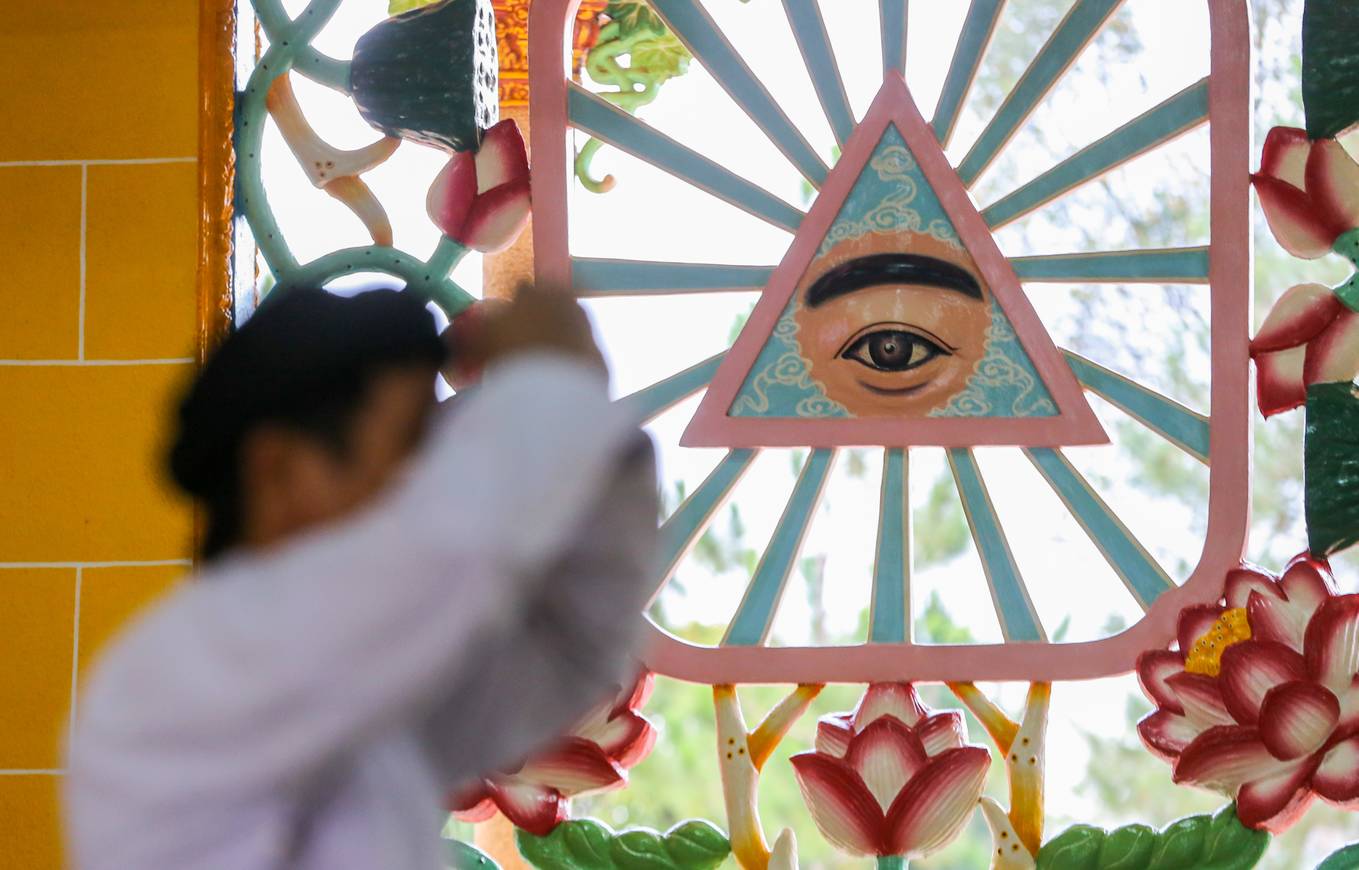
The icon of Caodaism is an eye in the triangle, symbolizing God. In addition, the religion also worshiped such as Buddha, Jesus, Confucius, Lao Tzu, Buddha Quan Yin ... These images are depicted many places around the Holy See, especially the main door.


In order to enter the interior of the Church, from the believer to the visitors must leave shoes outside. Visitors can not enter the main door but must go to the door, the door to the right, the door to the left, the door.


Inside the church there are two rows of dragons, painted blue, red, white. At the ceiling are nine sky clouds and stars.


The main hall of the Thien Mu Pagoda is located on a porch with 3,027 stars (representing 3,072 globes). Guests are not allowed to visit the center, take photos but just look at the power from both sides.


Visitors can visit the Holy See at any time of the day but should choose the holy hour (usually 12 hours) to see the solemn ceremonies of Cao Dai followers. At that time, guests can go upstairs to capture the whole interior of the Holy temple.


The 9th of January and the lunar August of the lunar calendar take place the two largest festivals of the Holy See, attracting many visitors.


There is always a custodian in the Holy See who reminds visitors of the Caodaism. "Guests are not allowed to take pictures of people taking the backdrop," said Hai.

Being the largest Holy Land of Cao Dai religion, Tay Ninh Holy See annually attracts millions of visitors and pilgrims. In the afternoon, this place becomes a relaxing place for the locals.

A secret basement in a hundred-year-old building in Saigon

A secret basement in a hundred-year-old building in Saigon


The basement in museum Ho Chi Minh City of 1,400 m2, has six layers of iron doors, withstand the 500 kg guns and bombs.


The building of the Ho Chi Minh Museum (Ly Tu Trong Street, District 1) was once named Dinh Gia Long, designed by French architect Alfres Foulhoux, built between 1885 and 1890.

The building was used as the Commercial Museum and then as a residence for the governor of Nam Ky Hoefel. In 1962, when the Independence Palace (now the Unification Palace) was completely destroyed by bombing, the project became the temporary residence and residence of the President of the Republic of Vietnam Ngo Dinh Diem.


While waiting for the newly independent Palace to complete, fearing a coup or bombing, the Ngo family thought of designing a shelter in Gia Long Palace.

Architect Ngo Viet Thu was assigned to design the basement but later he went to the US, the work was Phan Dinh Tan engineers take over. The tunnel was started from 5/1962 to 30/10/1963 completed. Entrance is located at the two ends of the corridor, about 2 m high, just one person walking.


The tunnel was dug deep into the ground 4 m, cast by reinforced concrete with 170 kg of iron per m3 of concrete, with walls up to one meter thick. By design, the tunnel can withstand 500 kg guns and bombs.


The tunnel has 6 iron doors are molded monolith, rudder to lock, large iron pin to install when trouble.


If there are problems, only after 5 minutes the essence is brought down the tunnel. Inside the tunnel full of external communication system.


The total area of ​​the tunnel is approximately 1400 m2. The space is divided into 6 rooms through the corridors. The base is cemented or paved with flowers.


Guest room of President Ngo Dinh Diem under the basement. By design, the tunnel can withstand 500 kg guns and bombs.


At present, large rooms are displayed many pictures of the formation, development of Dinh Gia Long.


The design of the basement below the Gia Long Palace is on display. According to calculations, complete tunnel with a total cost of more than 12.5 million - a huge amount of money at that time.


An old article about the coup of November 1, 1963. At that time, two Ngo Dinh Diem brothers - Ngo Dinh Nhu fled to the shelter and moved by car through Cho Lon, hiding in Father Tam's church. Later, the cousin of Wu was arrested by the opposition.


Entrance of the basement is located in the back of the mansion. There are two roads leading to Nam Ky Khoi Nghia and Pasteur streets, which are camouflaged by small blocks of potted plants.


Currently, Gia Long Palace is preserved quite intact. Due to the flooded sections being repaired, tunnels are only partially open for visitors.


Ho Chi Minh Museum is a tourist attraction attracting many domestic and foreign tourists. Recently, the building became an interesting point of interest for young people and many couples.


For tours to Saigon, please click here!

The 150-year-old building having thousands of antiques in Saigon

The 150-year-old building having thousands of antiques in Saigon


French architectural works are preserving about 2,000 antiques, open free for visitors.


The seminary of St. Joseph of Saigon (No. 6 Ton Duc Thang Street, District 1) was built in 1863. Since 2005, a building in the Grand Seminary has been used as a traditional house displaying antiques, statues Engravings, religious and folk art paintings ...


The building was one of the first French buildings in Saigon, still quite intact. Previously, this place was used as the living room of the Major Seminary. The corridors display many items of Vietnamese farmers hundreds of years ago such as horse carts, water wheels, rice mortars, plows, harrows ...


Inside are two galleries displaying 2,000 antiques from Vietnam and the world. "The antiquities I collected in the early 1990s, in addition to many dishes of churches, international guests, foreign organizations donated," said Rev. Nguyen Huu Triet, representative of the Major Seminary. 


The most famous are the items of Vietnamese people in Dong Son culture such as lamp, spoon, terracotta, jewelry ... A lamp made of Dong Son at the same time, around the 5th century BC showed that the Vietnamese already know how to use metal.


The traditional house also includes a collection of 650 ancient lights in Vietnam and other countries. The lamps are rich in designs, diverse in materials from terracotta, copper, ceramic, wood, iron, glass ...


Quite a lot of household items of the Vietnamese in the 19th century such as cabinets, tables, hills, screens, peaks ... are displayed.


The Book of Wisdom, the classic work of the Pentateuch as the foundation of Confucianism, was printed during the reign of Minh Mang, the Nguyen dynasty.


There are many antiques of other cultures that existed in Vietnam such as Cham Pa, Sa Huynh, Oc Eo ... At the entrance are two Sa Huynh land jars used for burial. dating back to the 5th century BCE.


The stone statues of the Khmer, dating back to the 12th century. This is a period of brilliant development of the Khmer kingdom with vast territory, strong development in Southeast Asia.


The artifacts of nations in Asia, Europe are kept in traditional homes. This bronze bell came from the Cantonese (China) region around the 18th century.


French clock in the 19th century with a height of nearly 2 m, carved sophisticated.


Many antique objects of the early 20th century Highland ethnic groups such as tombs, tombs, drums, gongs ... show the diversity of artifacts on display. Traditional houses are open daily for visitors.

One pillar pagoda – a cultural highlight of Hanoi

One pillar pagoda – a cultural highlight of Hanoi One Pillar Pagoda is located in the heart of Hanoi capital. Near Ho Chi Minh Museum, ...